
Topic: “Dialogue toward Authentic Community”
by Larry Philbrook, CTF, IAF-CPF Emeritus
From <The Power of Dialogue- Conversations with Masters> series
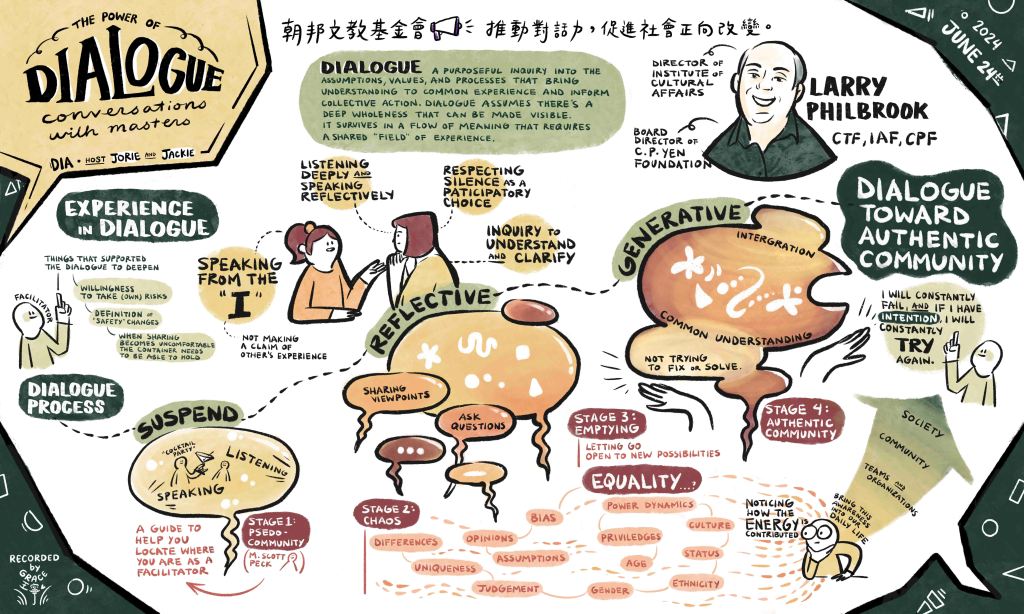
graphic recorder: Grace Wang
Written by Keli Yen
“Dialogue toward Authentic Community” is the topic for the CP Yen Foundation’s June 2024 Dialogue with Masters seminar with the guest speaker is Larry Philbrook, Certified Professional Facilitator.
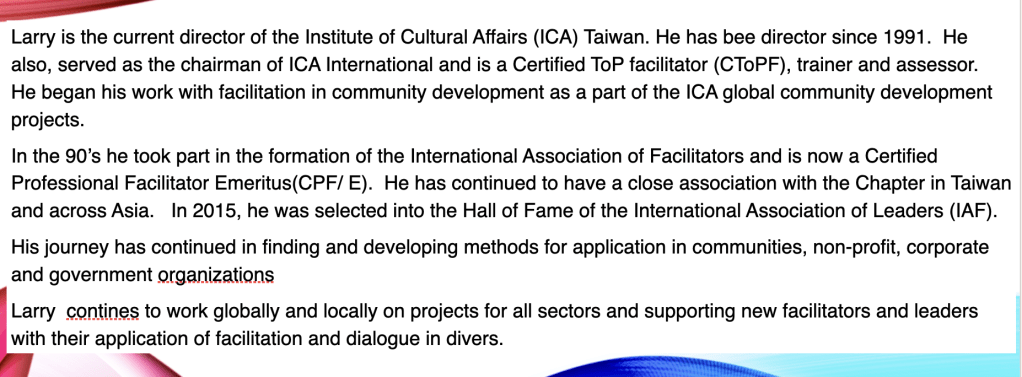
Larry is also a newly elected board director of the CP Yen Foundation 2024-2028.
The seminar opens with a quote by management thought leader Peter Senge:

Larry explains: Peter Senge got me into dialogue through his book “The Fifth Discipline”, published in 1990, in which “Team Learning” is one of the disciplines of a learning organization. We looked deeper and realized that his core practices were inquiry-advocacy and dialogue which inspired us to learn more about dialogue.
Many of the dialogues I facilitate are in corporate situations with leadership teams. One of the challenges in that context is to build enough sense of safety for people to talk about what they need to talk about. I was recently working with a company on the topic of vision, I asked “What’s your hope for the future?” The first responder talked about the pain he experienced trying to lead in the organization, as I invited each person in the group to express, they also chose to talk about what they were struggling with. Dialogue is not limited by the question, it’s an invitation to speak about what I and others feel needs to be said at the moment.
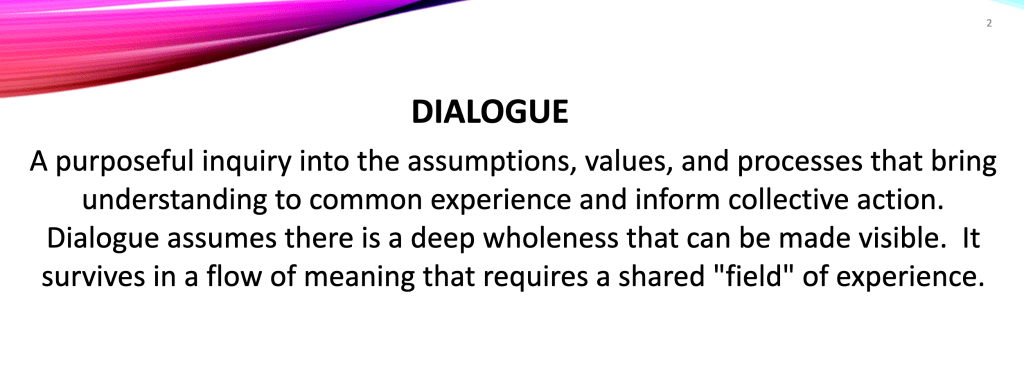
Here is a definition of dialogue by David Bohm:
Think about dialogue as a “container” that a group of people generate together. In this webinar, we’ve already started to create a dialogue with the short check-in text you wrote in the chatbox. Through that action, we began to build our container with 3 intersecting dynamics, shown in the image below:
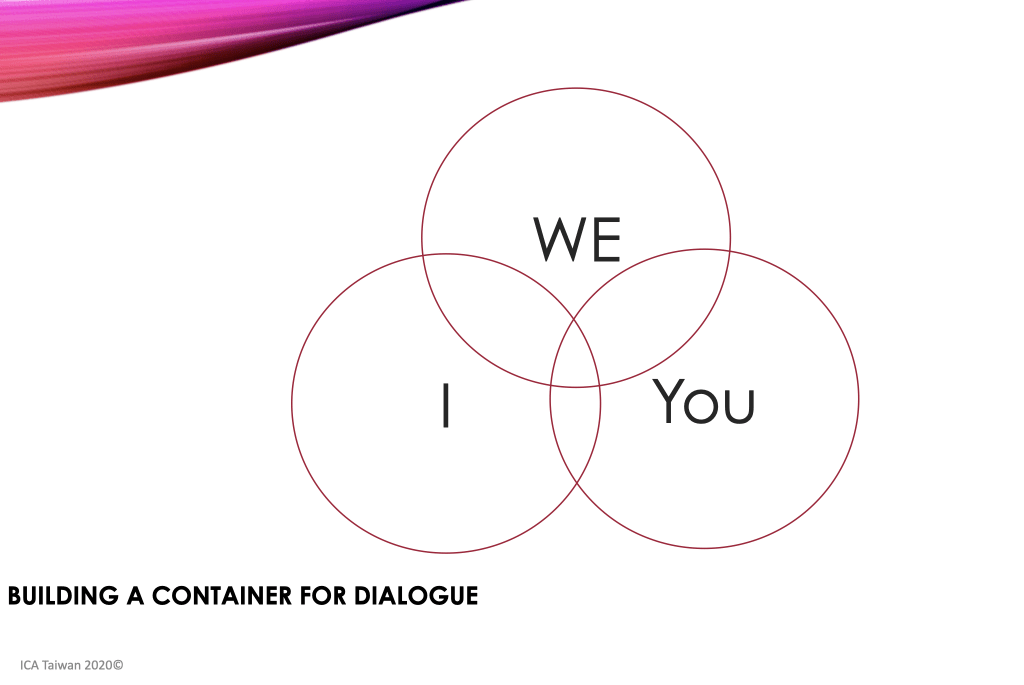
- I = my voice, what I can hear and say
- You = You expressing yourself
- We = how each perspective creates an opportunity to explore
The image below is by Daniel Yankovich showing the essential dialogue dynamics of equality, empathic listening and surfacing assumptions. For me, intention is the key piece.
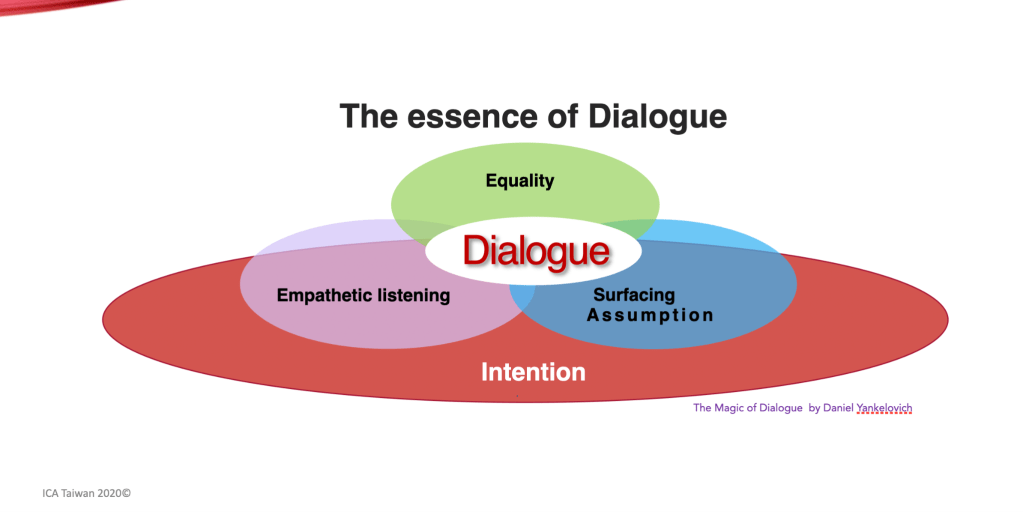
Having intention means that it’s OK to fail because I know I can try again. In dialogue, if you feel like things aren’t going deeper, it’s okay to express that as your feeling and then to share further or to invite others with a new question or to listen to each other. Each moment is a new moment.
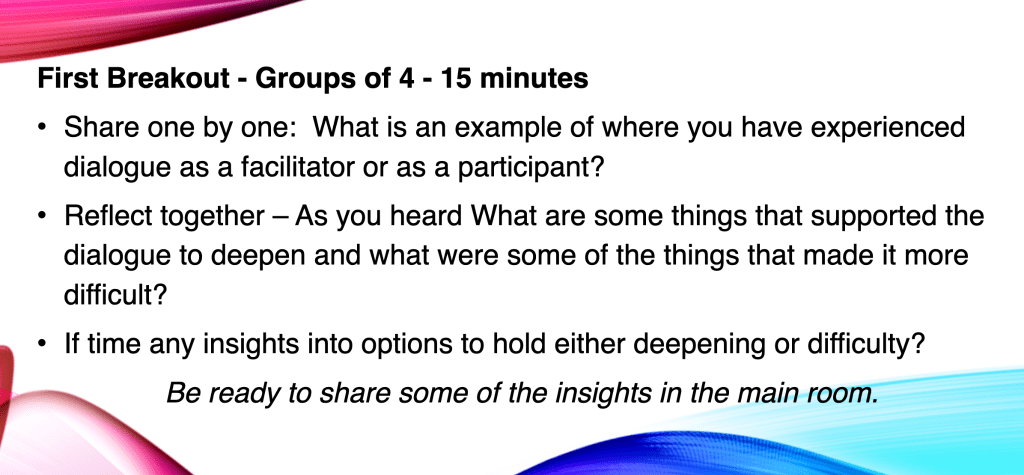
In the first breakout session, you will each give an example of where you’ve experienced dialogue. In this exercise, describe an experience you’ve had of dialogue. After you’ve listened to each other, identify what enables dialogue to go deeper. In your experience, what are things that can be an invitation to go deeper? Or what are things that can make it more difficult to go deeper?
There are three levels of listening in dialogue. The first level is about sharing enough to feel safe to share, to build a container with our stories. At the second level, dialogue deepens and naturally begins to feel unsafe. This is when the container is tested because the dialogue feels uncomfortable as the group tries to listen to each other’s sharing or hears something that one disagrees with or feels challenged or vulnerable by.
Dialogue is firstly an experience of being in the process of dialogue. As a facilitator, my role is foremost to be a participant in the dialogue, and realizing that was a shock for me. This means that if I ask questions to help you do the work that you want and need to do, it actually can make the dialogue more difficult. In a dialogue, the primary guideline is to speak from “I”. If I am asking a question it is because this is the question that I think is best for me, you and the group in this moment.
The diagram below shows my favorite dialogue guidelines:
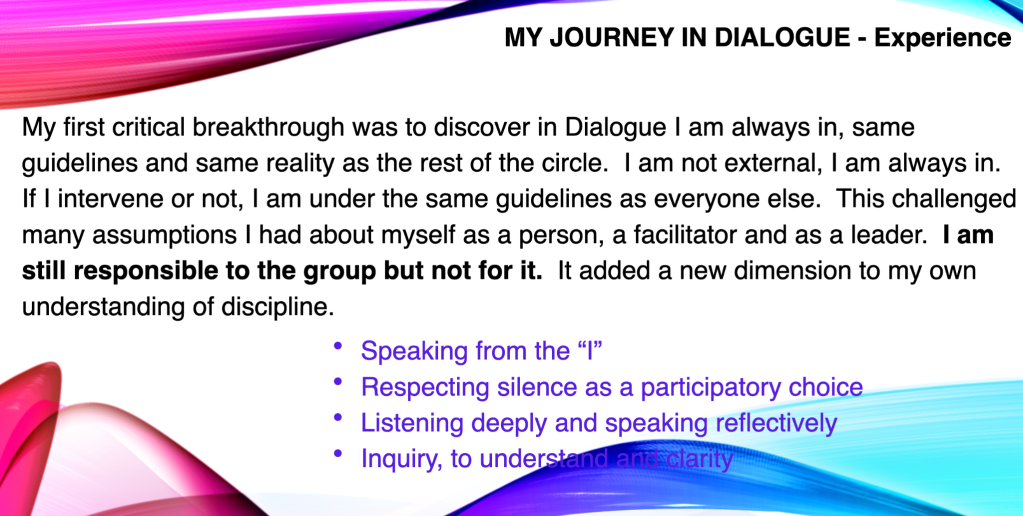
- Speak from the “I” means to speak from a personal voice.
- Respect silence as a participatory choice, including my own silence
- Listen deeply, speak reflectively, and Inquire to understand
The journey of taking the dialogue deeper from the first level of suspension of listening and speaking, to reflective dialogue is shown in the next diagram developed by William Isaacs, author of the book “Dialogue: The Art of Thinking Together”.
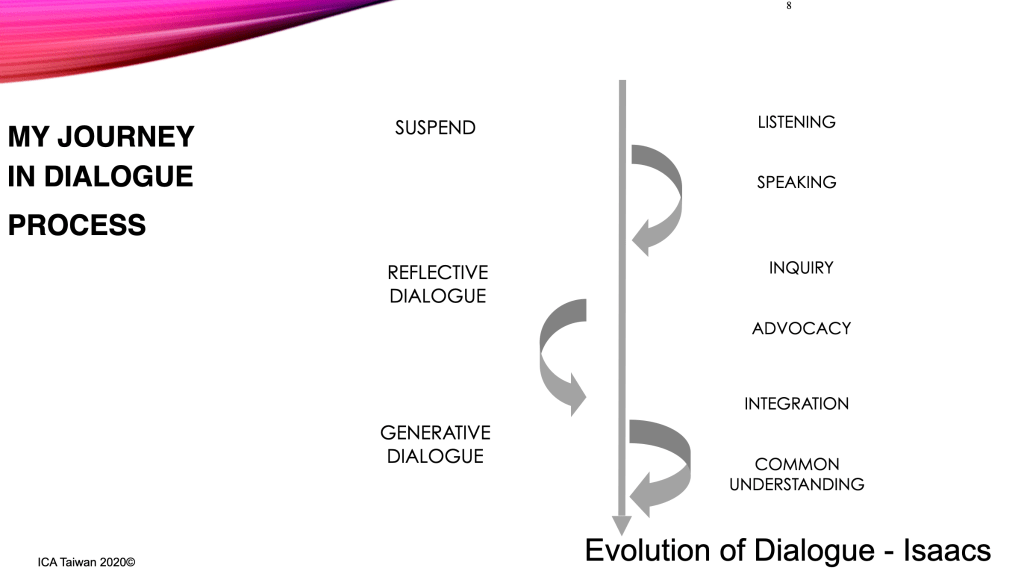
The first level of dialogue is called suspension and is about speaking and listening to each other’s story, not challenging each other. Dialogues can be powerful at this level because for many groups there are so few times that we listen deeply and authentically to each other.
After you’ve listened, there’s an opportunity to go into what’s called “Reflective dialogue” in which inquiry and advocacy occurs. Inquiry means asking questions or trying to understand what the other person is talking about. Advocacy means speaking one’s viewpoint. We don’t need to agree in dialogue, but we want to understand each other better.
Isaacs calls the third level generative dialogue. At this point you’ve already heard the different stories, you’ve challenged and questioned each other, and now you’re beginning to get an insight into how a new thought and integration can emerge.
Earlier, I told the story about a person who talked about his pain instead of answering the question I’d asked. By suspending the topic, he created an invitation for other people to share their pain and deepened the feeling of safety in the group. The safety was created by listening to each other, not agreeing or fixing, resulting in the emergence of a collective understanding that we’re all in pain. That understanding was a breakthrough and a new integration.
Dialogue has changed everything about the way I facilitate. Previously I’d spent most of my time focusing on the flow and the result of the facilitation, but dialogue puts my focus on the experience of the group. My background is in developing organizations and communities. The more I worked in dialogue I discovered that I could be more in dialogue every day. If a team or organization could have a sense of safety and deepening dialogue, what about a community or society? Jorie Wu mentioned the CP Yen Foundation’s Dialogue Impact Awards which recognize projects applying dialogue in a social context. I believe that’s the future and what society needs right now. This takes us back to the Peter Senge quote that we’re not having deep enough public conversations.
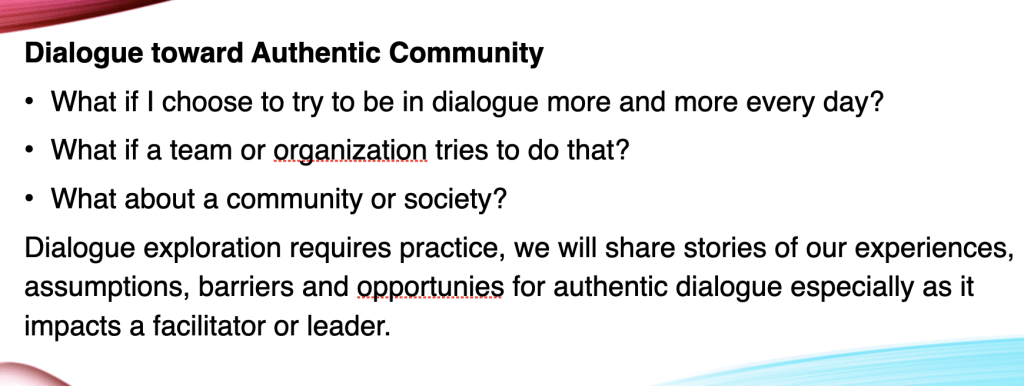
We’ll go into our 2nd breakout session about how we take dialogue into our lives:
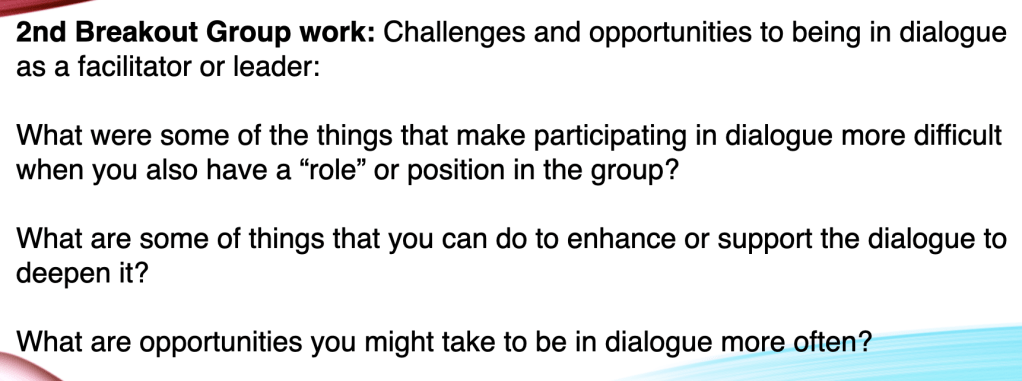
What are some of the things that make participating in dialogue more difficult? What can you do to support the deepening of the dialogue? And what are opportunities you might take to be in dialogue more often?
If I can be open and accepting of you and me, then I could be holding the space for a dialogue. That doesn’t mean you’re in a dialogue, it simply means that the space is available. Most of the time when I do that the other person feels invited, and the energy in the conversation changes because they either consciously or unconsciously understand that I am trying to listen. I am trying to share, not to fix them, but to be authentically with them in that space. By being more aware I can help myself go deeper into dialogue and through taking myself deeper invite you to join me.
The last slide is the first model that I ever worked with on dialogue, developed by M. Scott Peck. He says that whenever you’re working on dialogue you are always in one of these four stages or levels which are not necessarily sequential:
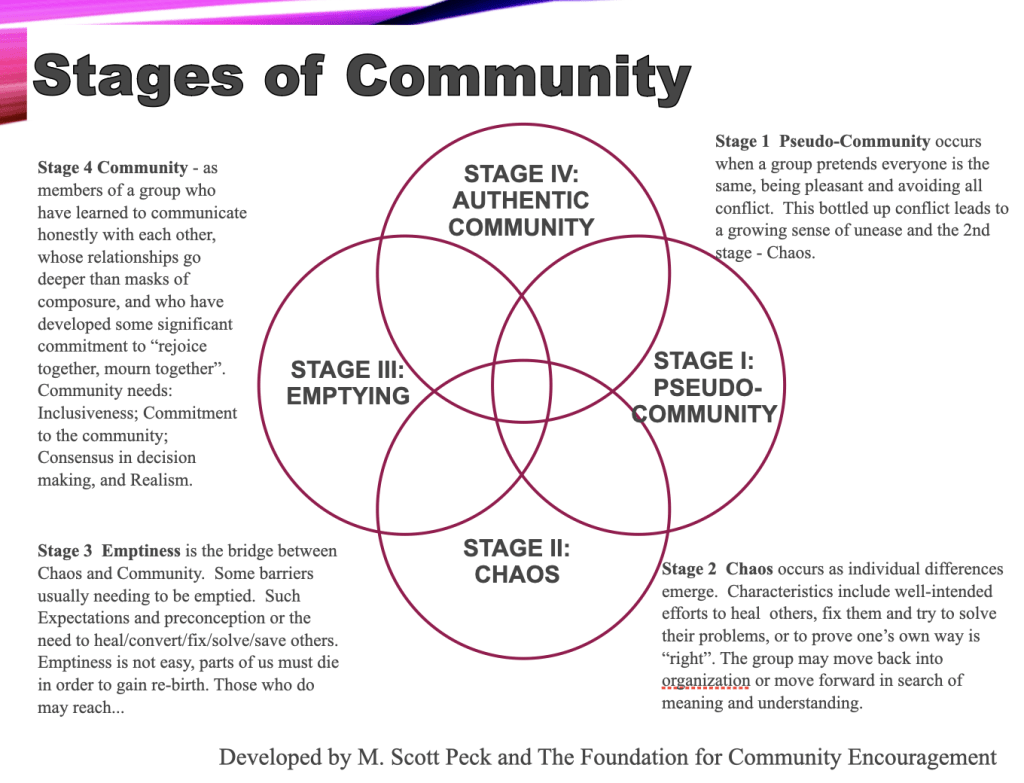
Scott Peck and William Isaac’s models have similarities. The 1st level of depth is called “Pseudo-community” in which participants behave as though everything is smooth, good and neutral. The 2nd level of depth is called “Chaos” which occurs when people tell their stories and others listen. As the stories are told they reveal that we have different perspectives and can create a sense of struggle about whether to explore the story, confront or withhold my own story.
The 3rd level of depth is called “Emptying” which means that after sharing my story, questions and feelings, and hearing yours, then I can let go enough to be open to other information or feelings. Letting the new emerge sometimes takes participants to the 4th level called “Authentic Community”.
I like this model because I always know where I am in it. For example, if I feel judgmental of others or myself that means I’m in chaos and the only way I can move deeper is to acknowledge it and let it go, sometimes to the group and sometimes not. If I let go, I create a space to listen, share or be. This is the original model of dialogue that I learned and it has made a difference to me every day in everything I do. Closing check-out – name one sentence or insight about this session about Authentic Community which lingers on your mind. Responses:
- Holding the space means we don’t try to fix it. We just try to understand.
- Deep conversation can create a meaningful connection.
- I need to allow myself to be more in the dialogue of chaos, maybe I’m too much in the cocktail party, and that’s my next step.
- Speaking from the “I” can make a dialogue happen.
- I can be in dialogue, regardless of whether other people are with me or not. Being in dialogue is an invitation to others to join me.
What lingers in your mind about this sharing? Let’s keep dialoguing~
#第六屆對話影響力徵件中,歡迎報名
我們始終相信,「對話」是促進 組織/社會正向改變的力量!
因為「對話」可以幫助組織在多元價值觀中釐清核心價值
因為「對話」可以幫助組織形塑多元、平等、包容的心理安全感場域
因為「對話」可以幫助組織激發學習與創意的成效
因此「對話」把人與人之間的鴻溝縮小了,「對話」把現況與理想拉近了,「對話」更拉近了衝突與和平之間的距離。
「對話」正是這個快速變化、多元融合、跨世代合作、永續發展的時代所需要的安定支柱與養份!
詳細內容:第六屆「對話影響力獎」徵件開始
*第六屆對話影響力獎甄選收件至8月23日中午12點截止
# 2024 對話影響力系列線上分享會-6
2024年第六場的《對話影響力獎線上分享會》,將由「若晨室內裝修有限公司 」&「台灣肥料股份有限公司企業工會」帶來寶貴經驗以及精彩分享。
得獎專案分享
(一) 若晨室內裝修有限公司【來場對話,"話"出長照居家環境改善的未來藍圖】 分享者:徐宛菱 專案經理
(二) 台灣肥料股份有限公司企業工會【台肥公司勞工董事直選倡議及實踐】 分享者:黃韋晨 理事長(9th)
主辦單位: 財團法人朝邦文教基金會
主持人:朝邦文教基金會引導師 宋豪軒(James)
活動日期:2024-8-5(一)
活動時間:19:30 ~ 21:30(台灣時間)
報名連結:https://www.accupass.com/event/2407010116533134091300
 朝邦文教基金會