
Topic: “ The power of conversations to fuel productive and meaning engagement”
by JACQUELINE (JACKIE) STAVROS
From <The Power of Dialogue- Conversations with Masters> series

Session summary By Larry Philbrook, CPF/E, CToPF, Board director of CP Yen Foundation and ICA Taiwan
graphic recorder: Grace Wang
It was a pleasure to listen and share with Dr Jackie Stavros as the opening session of Power of Dialogue 2025 hosted by CP Yen Foundation. She’s a professor at Lawrence Technological University, a researcher, an author, management consultant, and co-founder of the Conversations Worth Having Institute.
I have worked with Appreciative Inquiry for many years and find it critical to all aspects of my work in facilitation. Jackie did a phenomenal job in sharing her perspective and practice. At the end of the article I will share 2 of my breakthroughs stimulated by-Jackie’s presentation. The following is my best synopsis of her sharing with a short part in the end about my own breakthrough. She covered a lot in our 2 hours, so I have tried to cover the key parts.
Jackie started with the overview of focusing on the fundamental importance of dialogue, conversation, and communication in creating positive change, fostering collaboration, and building strong relationships. The power of asking the right questions, since questions either make you sink or soar. Appreciative is valuing people and situation, plus adding value. Inquiry is asking questions, being curious, wondering, and searching for what generates life.
If the questions are right they can
- Make the invisible visible
- Create shared understanding
- Generate new knowledge
- Inspire trust and possibilities
She spoke of this power of inquiry that depends on a different definition of right question. Right Question is “an inquiry that focuses on what is good, favorable, desirable, or of value to you and the person you are in a conversation with. It is an inquiry that is genuine!”
Jackie refers to it as “Humanistic AI” or Appreciative Inquiry (AI), founded by Dr. David Cooperrider focuses on strengths and possibilities to add value to people and the situation. Appreciative inquiry is not about ignoring the negative. It’s about seeing the world differently. And I remember the very first article I read about Appreciative Inquiry, and that was back when I had David Cooperider as an instructor. He was teaching a qualitative research class. It was called, Appreciative Ways of Knowing.
Appreciative questions are questions that demonstrate what you are naturally curious about such as “How did you put that data together? What made you pull that together so quickly?” , and then your question might be “What did you really like and how do I do this?” This curiosity moves us into conversation worth having, where we’re doing more than making each other feel good and advocating for our positions.
Jackie helped us to explore AI (Appreciative Inquiry) as an opportunity, a practice, and a mindset. Starting with the “simple” difference between advancing with an Appreciative Tone (adds value & values others and what is). She called this “above the line”- we live in curiosity, listen deeply, speak unarguably, question all their beliefs, and live a life of play = it is an appreciative space. And with a Depreciative Tone: (devalues and critical of others and what Is) as “below the line where we tend to go into “protect” mode.
Protect mode is easy to trigger, our brain is programmed to perceive threats, and when it does, a chemical cocktail courses through our veins, and we go below the line. In neuroscience, they describe that we only have a split second before the amygdala is hijacked, and the conversation is spiraling downwards into a negative space.
In that moment, however we have a choice, and the first step is about “Tuning in.” This begins with a pause to stop that downward spiral and brings you up to the line, and when you breathe, and you take a deep breath or 2; it begins to reset you, and then you have the option to become curious and be in that appreciative generative space. Ask yourself, “Where am I?" to assess your current state.
In that space of awareness, Appreciative Inquiry can show up for me. I can choose to be curious rather than simply reactive.
Appreciative Inquiry is part of what is Dialogical organization development (OD). Barbara Fredrickson, in her research, wrote some great articles on what good are positive emotions, and she came up with the positivity ratio of 3 to 1. If we can move into a positive space, vast potential can be realized. It’s the nature of our conversations that really makes all the difference. This research is summarized in Chapter 7 of Conversations Worth Having: Using Appreciative Inquiry to Fuel Productive and Meaningful Engagement.
What kind of conversations are we having with in our organizations, family, and communities? Are they above the line (appreciative space) or below the line (depreciative space)? If above or below the line, how do we get them to a conversation worth having? It’s about asking great questions – we call it generative questions. For example, instead of asking “Why is this project failing?", a generative question might be “What aspects of this project are working well and how can we build on those successes?"
The power of generativity and positive framing in your dialogue is the power of curiosity and openness. Jackie shared two simple practices, generative questions and positive framing. By using either of these or both you’re having a conversation worth having, and it doesn’t matter which one you start with. They change the way people think, and they stimulate compelling images for people to act on. If you want a deep dive into these two practices, see Chapter 4 in Conversations Worth Having. Or, check out the website: www.conversationsworthhaving.today to learn more.
The final part of her presentation was how to use these practices in strategic conversations. She introduced the SOAR framework (Strengths, Opportunities, Aspirations, Results) as tools for strategic thinking, planning, leading, and coaching. Check out the website: www.soar-strategy.com in the Resource Section for more information.
We explored practical strategies for Better Conversations sharing concrete experience, techniques, and strategies for improving conversations, including active listening, positive framing, generative questioning, and “do-over" conversations. (At the end of the article there is more detail on these tools). It encourages us to be intentional in communication, to consider the impact of words, and to strive to create environments that support growth, learning, and well-being. Jackie emphasized, “what you think, say, and do impacts self and others”.
An open or curious mindset supports discovery and relationships while a fixed mindset decreases engagement and fosters distrust and defensiveness. It will weaken relationships and put people in that Protect mode. Promote open dialogues and use Appreciative Inquiry to counter these negative effects.
Look at the questions you are asking: Are you trying to surface assumptions? Are you trying to create shared understanding? Are you trying to create shared outcomes? Are you trying to get everyone connected? Are you trying to widen the view? Are you trying to make it a shift? Are you trying to build trust?
Finally, if I am having critical conversations or destructive ones, what do I do? How do I shift it above the line? And how do I inspire people to act and to be empowered?
- Addressing Difficult Questions: Practice emotional intelligence by tuning in and being curious when faced with awkward or offensive questions. Recognize that the person may not realize they are being disrespectful and address it by expressing how their words make you feel. If someone asks an inappropriate question, respond by saying, “I’m curious, what led you to ask that question?"
- Addressing Critical Questions is a normal part of life and conversations. The key is to approach them from an appreciative space, seeking to understand and explore possibilities. Instead of reacting defensively to a critical question, respond with curiosity: “That’s an interesting point. Can you tell me more about what led you to that conclusion?"
On a closing note, I found Jackie Stavros profoundly helpful in the way that she shared the reality and the challenges of living into AI as a mindset and a practice. This is what I too have been working on for a long time. One of her examples woke me up to something I have been missing. I realized I have often confused acceptance with pursuing conscious appreciative exploration. Her example was when someone arrives late what do we do? My tradition is to affirm that it is no problem, and we can go ahead. This is one form of appreciation and affirmation, but Jackie’s sharing made me realize I am missing another opportunity for Appreciative Inquiry. What is positive in the pattern for the other? What creative approaches can support their need while respecting my own? Another practice was when Jackie reminded us that “do-over” is an option, it takes vulnerability and courage, but when we do that it has the option of shifting the pattern for the future. I began to think of all the times I failed, then reminded myself of curiosity with myself as well, for both practices when have I succeeded? What practices do I have that will help me? Who are my friends (like Jackie) that I can ask for support?
And away I go on a positive path of curiosity.
It is so great to come back to a familiar space and have a breakthrough.
Thank you, Jackie and all the others in conversation and to CP Yen for hosting it.
Frameworks shared: 5 D, Power of Generative questions, Positive Framing (Flip it), and SOAR
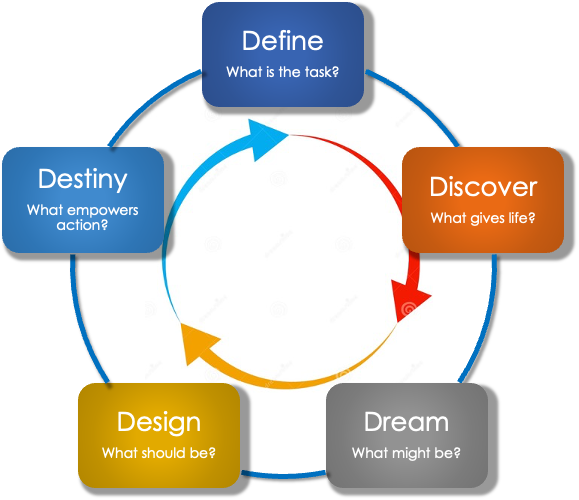
The 5-D Cycle has 5 generative questions that can be used to guide a conversation between two people, a team, or entire organization. It can serve as a framework for personal/professional development or coaching.
What is the Power of Generativity? The Power of Generative Questions and Positive Framing
- Four types of conversations with two dimensions
- #1: Appreciative and Depreciative
- #2: Questions and Statements
- What is a generative question?
- To ask self
- To ask others
The Power of Generative Questions
- Stimulate creativity and innovation: “What might be possible if we merge our two research ideas?”
- Challenge our ordinary ways of thinking: “What else make explain what happened?”
- Make room for diverse and different perspectives: “How do you see it?”
- Surface new information: “How did they manage that process at your previous position?”
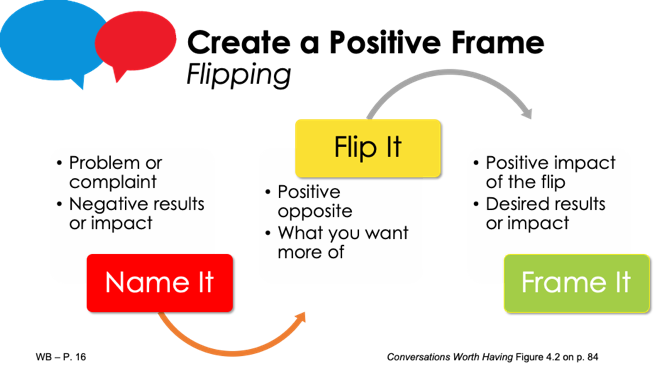
Positive Framing
Talk about what you want . . .
for yourself, with your colleagues, communities, and family. Instead of saying “We have a communication problem," reframe it as “We want to improve our communication to foster better collaboration."
Generative Questions:
- When was a time you were flourishing in your work?
- When do you feel most connected to your work?
- What resources might help you succeed?
Try a Do-Over
- Think of a recent negative conversation you were in.
- Tune In: Pause. Breathe. Get curious:
- What were the facts? Just the facts.What story did you make up?
- What other stories could explain the same facts?
- Frame: If you were doing this over, what might you do differently?
- What would you like to talk about?
- What outcome would you prefer?
- Make an appointment with that person. Begin with transparency: “I don’t like the way our conversation went … I apologize for my role in it. I would like to start over. My intention is … (insert your positive frame)
How can your questions help others to SOAR?

SOAR is a profoundly positive approach to strategic thinking, planning, conversations, and leading that allows a group, organization, or community to construct its future through collaboration, shared understanding, and a commitment to action on any topic you wish to discuss.
📣 2025 第七屆對話影響力獎徵件開始!
用「對話」創造改變,用傾聽與包容連結世界!
對話能釐清價值、營造心理安全、激發創意與共好,是改變的起點,也是希望的力量。
如果您正在推動改變、實踐多元平等、促進溝通理解——
邀請您站上這個舞台,讓精彩故事被世界看見!
立即報名!
⸻
1. 網站線上報名: 第七屆「對話影響力獎」徵件開始
2. 下載表格,填寫後寄至:dia.cpyen@gmail.com
3. 聯絡窗口:黃小姐 (Fanny) 02-2771-0168#24
4. 投件截止:2025年8月25日 (一) 中午12點前
5. 評選時程:9–10月進行訪談與評審,11月中旬公布得獎名單
6. 頒獎典禮:2025年12月6日 (六) 上午9:00–12:00
# 對話影響力獎分享會-社區大學全國促進會秘書處/流域學校聯盟
萬物有靈,對話有光——溪畔議會的跨物種交響
您曾體驗過,在曾文溪上、下游溪畔,由雨水與石頭共同開場的「萬物議會」嗎?
那不只是藝術家的創作現場,更是一場跨物種、跨領域的對話實驗。
誠摯邀請您參與對話影響力獎得主「社團法人社區大學全國促進會/流域學校聯盟代表人: 楊志彬」線上分享會,與我們一同傾聽萬物的低語,想像更多對話促進合作與未來的可能。
對話影響力獎得獎單位:社區大學全國促進會秘書處/流域學校聯盟
分享主題:2022 Mattauw大地藝術季之萬物議會— 打造流域共同體的新社會對話行動
分享者:楊志彬秘書長
主辦單位:朝邦文教基金會
主持人: Vincent 陳明勇 引導師 / 董事
日期:2025年5月5日(星期一)
時間:19:30~21:30 (台灣時間)
報名連結:
https://www.accupass.com/event/2504070824555807856400
 朝邦文教基金會