
Topic: “ Grace Under Fire: Strength, Flexibility, and Compassion in Tough Conversations”
by Larry Dressler, founder of Blue Wing Consulting
From <The Power of Dialogue- Conversations with Masters> series
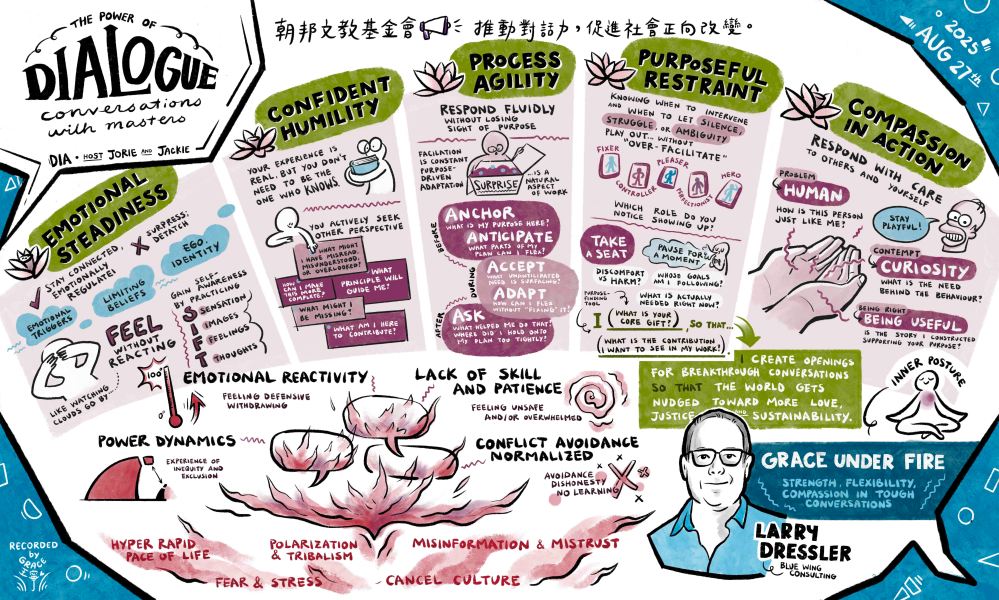
graphic recorder: Grace Wang
August 27, 2025 . written by Keli Yen, board director of CP Yen Foundation
Larry Dressler’s more than 25 years of facilitation can be understood through his purpose statement: “I create openings for breakthrough conversations so that the world gets nudged toward more love, justice, and sustainability." Clarity of purpose is one Larry’s best practices for presencing “grace under fire”, in other words, how to facilitate with strength, flexibility and compassion during tough conversations.
Larry specializes in supporting leaders to develop authentic engagement and collaboration in their organizations. He is the author of the books “Consensus Through Conversation: How to Achieve High Commitment Decisions” and “Standing in the Fire: Leading High- Heat Meetings with Clarity, Calm, and Courage”. In the CPYF Dialogue with Masters August 2025 session, Larry tells us about the principles and practices he uses to develop a facilitator’s “inner container”, characterized by the capacities of emotional steadiness, confident humility, process agility, purposeful restraint and compassion in action; read on to discover specific practices to develop each capacity.
What is an “Inner Container”?
Facilitators are usually invited into a situation when the stakeholders feel stuck on a difficult issue. The challenge is often complex and important to the stakeholders, and can arouse strong feelings about the issue. Facilitators come well-trained on how to build a group “container” for participants to feel safe enough to engage in open communication, collaboration and learning. An “inner container”, by contrast, refers to the facilitator’s personal capacity to respond effectively in difficult situations. A resilient inner container enables a facilitator to be composed, grounded, and responsive based on wisdom rather than emotional reactivity—especially at times of heated conflict, confusion or emotional intensity.
How to develop an “inner container”?
Facilitating with grace is the result of five fundamental capacities, described by Larry below and elaborated by practices that cultivate mastery in each capacity.
1. Emotional Steadiness
The capacity to feel serene even when things aren’t going well. This doesn’t mean being detached or suppressing emotions, but rather being aware of one’s feelings without being overwhelmed and controlled by them.
- The “SIFT Practice”
The simple act of self-awareness contributes to emotional steadiness and gives you a chance to adjust your emotions to serve the purpose of the work at hand. To increase your capacity for emotional management, reflect on each of the following:
- Sensations (S) – Be aware of the physical sensations in your body. Observe without judgment, just notice.
- Images (I) – What mental images are present in your awareness? (e.g., visual scenes, memories, colors, etc.).
- Feelings (F) – What emotions do you notice right now? Can you name them? Notice without trying to change or suppress them.
- Thoughts (T) – Observe your thoughts. What self-talk or mental commentary is arising? Simply notice without judgement.
2. Confident humility
The capacity to balance confidence in one’s abilities with humility about one’s limitations. Humility reflects the inner container of awareness that you are only seeing part of the picture, and it inspires actively seeking other perspectives. Humility is important because it attracts people’s trust in you. People sense when a facilitator is grounded and open — not biased, judgmental, or holding a personal agenda.
- Practice: “What might I be missing here?”
To be aware of your blind spots and curious about what more you could learn from a situation, ask yourself, “What might I have misunderstood, overlooked or misread about this situation? What more can be understood if seen from another perspective?” - Practice: “Taking my seat"
This is a practice for having clarity about your purpose for being a facilitator and for being in any particular activity. When arriving at your seat in a meeting, take a moment to reflect for yourself:
“Who am I here for?
What am I here to contribute?
What principles will guide me?”
Larry personally responds to these questions by articulating his purpose as a statement, which is: “I create openings for breakthrough conversations so that the world gets nudged toward more love, justice, and sustainability."
You can use this formulate for create your own purpose statement as well: “I [blank] so that [blank]." The first blank is your core gift, and the second is the contribution you seek to make through your work.
3. Process Agility
The capacity to accept the unexpected and to be ready to let go of plans and to respond fluidly to what is needed in a situation without losing sight of your purpose. As a result you see surprises as a natural aspect of work. Process agility is important to have in an inner container because groups are living systems in constant change, facilitation is therefore a practice of mastering the art of constant purpose-driven adaptation.
- Practice: Five-A Habit”
Before the facilitation activity:
- Anchor yourself in your purpose for engaging in the activity. Ask yourself: What is my purpose here? What am I here to support?
- Anticipate – What are some decision-making points that I can anticipate? What parts of my plan can I flex?
- Practice: Five-A Habit”
During the facilitation activity:
- Accept what has just showed up and try to identify what unanticipated need is surfacing.
- Adapt – Ask yourself how does this moment ask me to flex? How can I flex with purpose instead of fighting it or fixing it?
- Practice: Five-A Habit”
After the facilitation activity:
- Ask yourself – Where did I adapt well? What helped me to do that? Where did I hold on to my plan too tightly? Why?
4. Purposeful Restraint
The capacity to know when to intervene and when to let silence, struggle or ambiguity to play out. Purposeful restraint is when you decide to trust the group’s wisdom and resist the impulse to fix or explain. Instead, you use silence as a productive space in which people can process questions, thoughts and emotions. This restraint is important because growth, insight, shared commitment and action happen in the process of struggle. If a facilitator intervenes in the struggle too early, it will disrupt the group’s learning process. Common “Facilitator saboteurs” are the tendencies to be a:
Fixer – Characterised by discomfort with silence or conflict. The saboteur voice says: “This is awkward. I need to fix it.”
Controller – Characterised by a need to direct. The saboteur voice says: “ If I’m not actively guiding, I’m not facilitating.”
Pleaser – Characterised by fear of being judged. The saboteur voice says: “They’ll think I’m not doing my job.”
Perfectionist – Characterised by intolerance for mistakes and messiness. The saboteur voice says: “I must make the one right move.”
Hero – Characterised by a lack of trust in the group. The saboteur voice says: “I am the only one who can rescue this situation.”
- Practice: “Take a beat"
This practice enables facilitators to pause and to assess whether intervention is necessary. Try asking yourself these questions before interrupting a group’s process:
- Is this discomfort necessary for progress or learning?
- Whose goals am I serving by waiting – or by acting?
- What might get worked out if I just pause and observe instead of act?
- Will my restraint result in harm (different from discomfort)?
- What is actually needed right now?
- How can I address the need (for example by being an encouraging and stabilizing presence) without speaking?
5. Compassion in Action
The capacity to respond with care toward yourself and others, even when someone is difficult, disrespectful or in pain. You demonstrate genuine warmth, care and patience without giving up your authority and purpose. Compassion in Action is important because when we recognize someone’s needs as valid, they become more willing to listen, open up and be vulnerable and to collaborate.
- Practice: Compassion Reframes
- Reframe a “Problem” as “Human” – Remember that this person has also known fear, wants to be heard or has been hurt… How else is this person just like me?
- Reframe “Contempt” as “Curiosity” – All behavior is communication. What unmet need might be behind this behavior?
- Reframe “Being Right” as “Being Useful” – Take ownership of the stories that you believe in. Is the story that I believe about this person true, complete, fair, supporting my purpose?
Reflect on these five capacities:
- Emotional steadiness,
- Confident humility,
- Process agility,
- Purposeful restraint and
- Compassion in action
Consider which ones are your greatest areas of growth?
What are you here to contribute?
What is the purpose for why you do your work? Try to create your purpose statement using the structure: “I [core gift] so that [contribution I seek to make]"
Mastery arises from practice and is refined through intentionality, consistency, presence, openness and adaptability. Let us know how it goes in your practice to develop your inner container for grace under fire.
# 2025 對話影響力獎分享會-台灣漢和國際精準放射醫療協會
診間裡流動的對話 開啟全人醫療的新篇章
大部分的人在醫院的診間看診,由於對病痛的恐懼及種種心裡因素,以及與醫生知識不對等的情況下,通常很難在醫病之間產生對話,尤其是病況較爲嚴重時,治療的方式,醫生就是診間的威權所在。郭理事長也是癌症的專門醫師,在他行醫二十多年來,透過對話,改變診間醫病的關係,為患者建立自信,也為許多病患及家屬之間建立更多的連結,除此之外,也創造了更多正向的醫療結果。
郭醫師如何體會對話在治療過程中的重要性?
診間有哪些困難的對話?
醫生如何透過對話建立病患的自信?
醫病之間如何透過對話共創最佳的醫療結果?
如果你/妳是醫護人員一定不要錯過郭醫生的經驗分享
如果你/妳是非醫護人員更不可錯過這個難得的診間對話故事
對話影響力獎得獎單位:台灣漢和國際精準放射醫療協會
分享主題:對話-大郭醫師的癌症診間微光故事
分享者:郭于誠 理事長
主持人:Jackie 張桂芬 引導師 / 副執行長
時間:2025/10/13 (一) 19:00~21:30
報名連結:https://www.accupass.com/event/2509040521051718586789
#12/6 第七屆對話影響力獎頒獎典禮暨對話實驗室 即將開始 敬請期待
「對話影響力獎」的目的在肯定個人、組織、社區積極推動對話元素(平等待人、同理聆聽、浮現假設、包容等有效溝通方式) ,促進組織變革,達成創新社區發展或共創更完善的解決方案、政策,並藉此活動讓人們看見聆聽、包容多元就在你我的日常。
典禮下午舉行「對話實驗室」,創造一個對話的場域,透過對話三元素與對話流程,討論重要議題。
在此誠摯地邀請您,一起讓對話的影響力被看見!
活動時間:2025-12-06(六) 09:00 ~ 12:30 第七屆對話影響力頒獎典禮(台灣時間)
13:30 ~ 17:00 對話實驗室
活動地點:台北文創中心 6樓D廳
主辦單位: 財團法人朝邦文教基金會
協辦單位:EMBA雜誌
 朝邦文教基金會