
Topic: “ The Living System of Conversation:
Generative Facilitation in A Complex Adaptive World”
by Peter Seah, CPFIM
From <The Power of Dialogue- Conversations with Masters> series
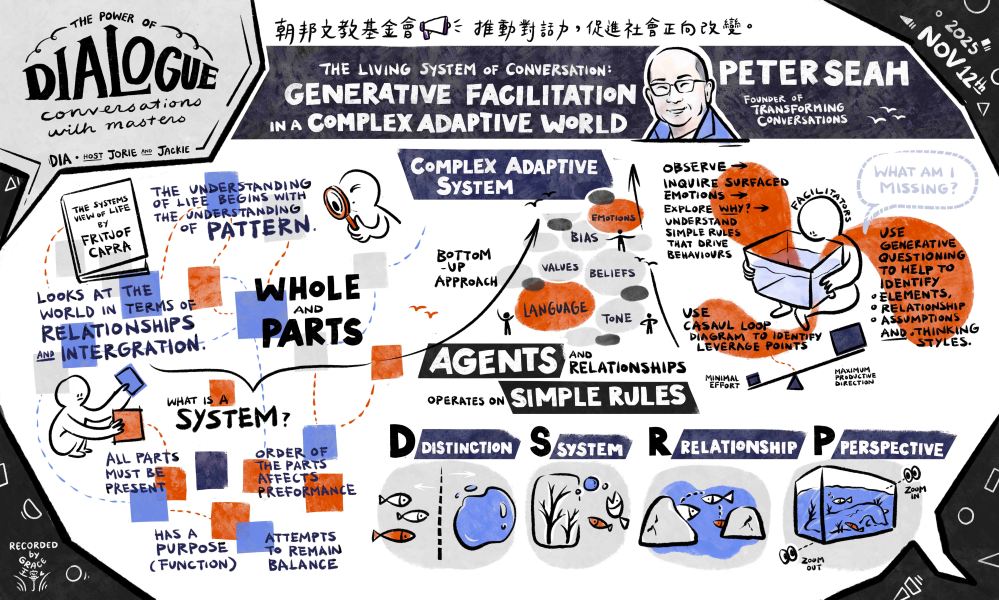
graphic recorder: Grace Wang
Session summary By Keli Yen, Board director of CP Yen Foundation
Are you interested in applying systems thinking in your facilitation? Are you curious what it means to be a “generative facilitator”? Peter Seah is a master in both, and in this dialogue series webinar, he gives us a quick dive into these concepts and how to put them into practice. Peter is a certified Master Professional Facilitator (CPFIM), an IAF Certified Assessor, and the Founder of Transforming Conversations Consulting Pte Ltd (Singapore).
The topic is broken down into three parts:
1. Understanding Complex Adaptive Systems (CAS)
2. The DSRP Methodology
3. Generative Facilitation in Practice
Part 1: Understanding Complex Adaptive Systems
“Complex Adaptive System” is a description of how nature operates. For example, think of the elegant twisty movements of a flock of birds. There appears to be no leader directing the group, so how do they move together? The answer is that a set of simple rules guides each bird’s behavior individually, and when they fly collectively, the pattern appears fluid and harmonious. The same is true with urban traffic. Vehicles know how to drive smoothly through a roundabout, even without traffic lights or officers directing them. Both birds and cars are examples of “complex adaptive systems” operating on the simple rules:
1. stay together,
2. don’t crash into each other
3. avoid obstacles/predators.
Companies also operate on simple rules, but often they are either not explicitly stated or there’s a difference between the rules that participants live by. Facilitators can help organisations better understand the rules driving their behaviour by making implicit rules explicit, enabling more effective self-management. The key insight here is that seemingly complex behaviours often emerge from simple underlying rules.
Topic 2: DSRP Methodology
DSRP stands for Distinctions, Systems, Relationships, and Perspectives and is a methodology for identifying and developing the simple rules of a complex adaptive system; it’s an approach developed by Dr. Derek and Laura Cabrera.
All systems are made up of contexts and boundaries, which can be referred to as the “whole”, and in every whole, there are “parts”. So to understand complexity we can begin by first distinguishing what the parts are.
“Distinctions” means defining an individual part, or “entity", by seeing how it is distinctively different from what it is not, or the “other". In a dialogue, this clarification helps to raise awareness of assumptions, biases, and notice what is overlooked.
“Systems” means organizing information into a “part" and “whole" structure and in other words, seeing how a component fits into the larger picture (for example, a household is part of a city). This helps to clarify how each part has a function in the system.
“Relationships” means understanding the “action" and “reaction" between different parts, in other words, how things interact and the consequences of those interactions.
“Perspectives” is an exploration of how each person’s different point of view perceives different aspects of the same system.
Peter demonstrated these concepts by asking participants to describe what they see in a fish tank. Participants named distinctions (fish vs. water), systems (oxygen exchange system), relationships (between stones and fish), and perspectives (what attracts attention first). The DSRP methodology can be a practical tool for dialogue by identifying the basic elements of an organisation, how their relationships function, the assumptions, connections and mental models of their perspectives, all of which help to understand better the simple rules driving their behaviour.
Topic 3: Generative Facilitation
Here are some ways facilitators can use the DSRP tool:
- Facilitators use themselves as containers to sense what’s happening in the room, then ask participants how they feel, and why they feel that way.
- Facilitators use generative questioning to help groups clarify their behavioral dynamics the rules influencing them.
- Facilitators map relationships using tools like causal loop diagrams to identify leverage points that show how minimal effort can produce maximum results.
Peter gave a case study of using DSRP in a company in which it was revealed that the director’s growth strategy focused on revenue was not aligned with the CEO’s focus on building trust in a new market. Peter asked questions which made this misalignment evident and enabled the conversation to shift in a more productive direction.
Peter also showed how he uses causal loop diagrams to map relationships between variables, showing reinforcing loops (where variables increase or decrease together) and balancing loops (where variables move in opposite directions to maintain equilibrium).
In Summary:
Peter reiterated the main insights that he hopes we take away from this session. That all systems:
- are complex adaptive systems
- have relationships and agents
- operate on simple rules
Practice:
“Generative facilitation is about allowing the facilitation to emerge as different aspects of the system emerge. The DSRP lens helps make that a continuous generative process." The DSRP methodology reminds us that, when facilitating a system, you are also part of it, so ask yourself what your point of view is. Because your view and questions affect group dynamics, ask yourself: How can I maintain balance between the big picture and the details? What parts could I be missing, and what are their relationships with each other? Peter encourages us to practice these skills because they can be invaluable in facilitating groups in addition to better understanding ourselves.op your inner container for grace under fire.
 朝邦文教基金會