
Topic: “Dialogue to Heal an Adversarial Worldview”
by Jo Nelson, CTF, IAF-CPF Emeritus
From <The Power of Dialogue- Conversations with Masters> series
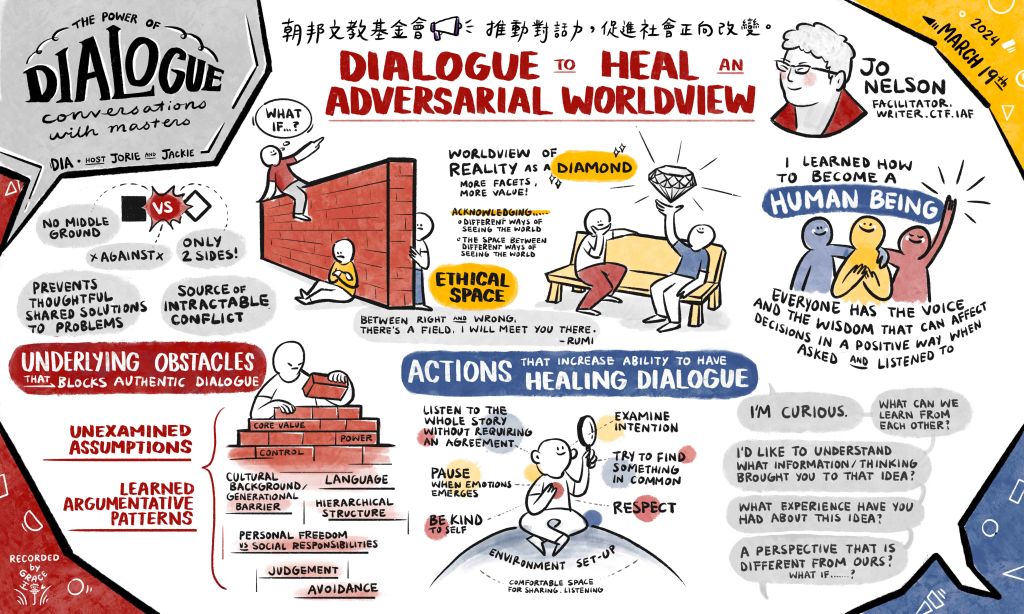
( graphic recorder: Grace Wang)
Written by Kimberly Bain, IAF- CPF/M
This session was part of the CP Yen Foundation Workshop series on the Power of Dialogue and featured Jo Nelson, CPF Emeritus on the topic of the use of dialogue to heal an adversarial worldview.
“Once a society loses this capacity [for dialogue] all that is left is a cacophony of voices battling it out to see who wins and who loses. There is no capacity to go deeper, to find a deeper meaning that transcends individual views and self-interest.” Peter Senge
On March 19th, 2024, 43 people joined together to consider how dialogue can be used to help heal an adversarial worldview. Jorie Wu, from CP Yen Foundation started the session with this quote by Peter Senge and encouraged everyone to be fully present, engage in and enjoy the mutual learning and be prepared to be surprised. She then introduced Jo Nelson as “an iconic figure in the profession of facilitation”. With over 50 years facilitating, teaching, mentoring and writing about facilitation, Jo has been inducted into the International Facilitators’ Hall of Fame and is currently working on the 2nd edition of Focused Conversations, scheduled for publication release in the fourth quarter of 2024.
Jo started the session with her belief that everyone on this planet wants to have a voice in the decisions that affect their lives, and that everyone has wisdom that can affect those decisions in a very positive way when asked and listened to. Her concern is that there is an underlying image that reality only has two sides and that this worldview that is intensifying in the 21st century. This two-sided worldview – right/wrong, for/against, us/them, left/right, good/bad, friend/enemy – does not allow for or acknowledge a middle ground and prevents the development of thoughtful shared solutions to problems.
Jo explained that a two-sided worldview is not all bad, after all the computer was developed from Is and 0s and turns off and on, but this view is currently blocking us from entering into authentic dialogues to find solutions to create a better future. When the underlying assumption is that reality only has two sides, it leads us to see alternative views as either with us or against us and stops us from considering a third way.
Rumi is quoted as saying, “between right and wrong there is a field and I will meet you there.” Jo referred to this as the ethical space between different views. She talked about two people sitting on opposite ends of a park bench and viewing the scene in front of them in very different ways. Both people are seeing the same thing but viewing it very differently. The ethical space is the space on the bench between them. Like Rumi’s field, the ethical space is the open space between the different views, it is the space where we can explore options, opportunities, commonalities and differences, the space where we can find solutions.
Jo reminded us that it is important to create a comfortable space (that mythical field or park bench) to hold the dialogue and that to address the adversarial mindset we should work from a place of curiosity. We need to ask questions like, ‘what if’, ‘I’d like to better understand your ideas’, ‘what information or thinking brought you to that idea’, ‘tell me more about your experiences’, ‘what do we have in common’, ‘where do we differ, ‘what might be a perspective on this that is different from either of ours’, ‘what can we learn from each other’, ‘what are we going to think about further after this conversation, given what we have said’.
Holding authentic dialogues to explore the differences between views allows for a deepening of understanding and opens the way for exploration of a middle ground. Jo provided the image of a diamond, the more facets a diamond has the more valuable it is. Authentic dialogues are like a multi faceted diamond. The more facets or perspectives that are brought into the conversation the richer the dialogue and the better the results.
After this thought-provoking introduction and imagery, participants went into small groups to discuss examples of where they have experienced an adversarial worldview. The groups were asked to discuss some things that in their experience sustain an adversarial worldview and block authentic dialogue and things we can do to address these blocks and increase our ability to have healing dialogues. The groups then shared their insights and thoughts and engaged in a reflective exercise to explore our collective learning.
Some of the blocks identified by the groups were culture, core values, power and politics. It was suggested that these blockages are often deeply rooted, are often hard to remove and continue to sprout new growth, keeping the argumentative two-sided worldview alive. It was suggested that language often frames the conflict and establishes the patterns, assumptions and emotions around a conflict. One participant said, “naming something gives it power”.
To address and remove the blockages we need to set a clear intention of curiosity. We need to be kind to ourselves and others. We need to share stories, not opinions. We need to carefully consider the language we are using. And most importantly we need to BREATH – ask then breath, listen then breath, consider then breath, respond then breath. Sometimes all it takes is a calming breath before responding and continuously repeating the mantra I am curious to move an argument into a dialogue. The session concluded with participants sharing their insights and take-aways. We discussed the importance of remembering that we are all human and we need to continuously learn what it means to be a human being. We need to remember that dialogue is always available. As human beings we have more in common than we do differences, and we need to dare to speak and welcome those differences. Humanizing our dialogues, rather than demonizing each other is key. It is important to separate arrival from the conversation, we often enter a dialogue thinking we need to arrive at a decision, rather than deepening understanding. If we focus on expanding understanding rather than making a decision we can engage in a more authentic dialogue and move away from the adversarial worldview.
# 第五屆朝邦對話影響力獎得獎分享與社區對話實驗室
朝邦基金會與國立臺灣海洋大學相遇在”第五屆對話影響力獎”。國立臺灣海洋大學以極為優秀的和平島USR 計畫獲得”第五屆對話影響力金牌獎”。隨後,基金會榮幸受海大團隊熱情邀約到和平島USR場域踏查,見識海大師生與基隆市府攜手合作,推動基隆產業與文化的成果,很令人欽佩與 讚賞。於是,我們開始想像如何在這豐富的場域開啟對話…
在此,我們誠摯邀請您參加由國立臺灣海洋大學和平島USR、朝邦文教基金會與基隆市政府共同合辦的「朝邦對話影響力獎得獎分享與社區對話實驗室」活動。
主辦單位:朝邦文教基金會、國立臺灣海洋大學和平島USR
協辦單位:基隆市政府
地點:八斗子岸置中心
日期時間:2024年4月19日下午1:30~4月20日下午1:30 (星期五、六)
活動費用:2500元/人(含對話影響力分享暨對話實驗室,第一天晚餐、海釣、住宿,第二天踏查、午餐,兩日保險費)
*需自行前往「八斗子岸置中心」活動現場(交通自理)
內容請參閱以下報名網頁,若您能參與兩天活動或任何單項活動,請協助填寫報名表。
報名連結:https://zh.surveymonkey.com/r/DIA20240419
# 2024 對話影響力系列線上分享會-3
第三場《2024對話影響力獎線上分享會》,將由「國立臺灣科技大學」&「甘樂文創志業股份有限公司」接棒,與各位分享如何將對話導入組織中,並將對話做為組織成員及團隊夥伴進行各方整合與協調時的重要DNA。
得獎專案分享
(一) 國立臺灣科技大學【EIA行動工程師培育計畫】 分享者:林明逸助教&陳宥誠助教
(二) 甘樂文創志業股份有限公司【三峽永續社區支持理念價值對話】 分享者:林峻丞執行長
主辦單位: 財團法人朝邦文教基金會
主持人:朝邦文教基金會引導師 宋豪軒(James)
活動日期:2024-5-6(一)
活動時間:19:30 ~ 21:30(台灣時間)
報名連結:https://www.accupass.com/event/2403290301181231985010
 朝邦文教基金會