
Topic: “ 重新敘事災難:邁向再生未來與韌性社區的對話”
“Re-Storying Disaster: Dialogues for Regenerative Futures and Resilient Communities"
by Bob Stilger
From <The Power of Dialogue- Conversations with Masters> series
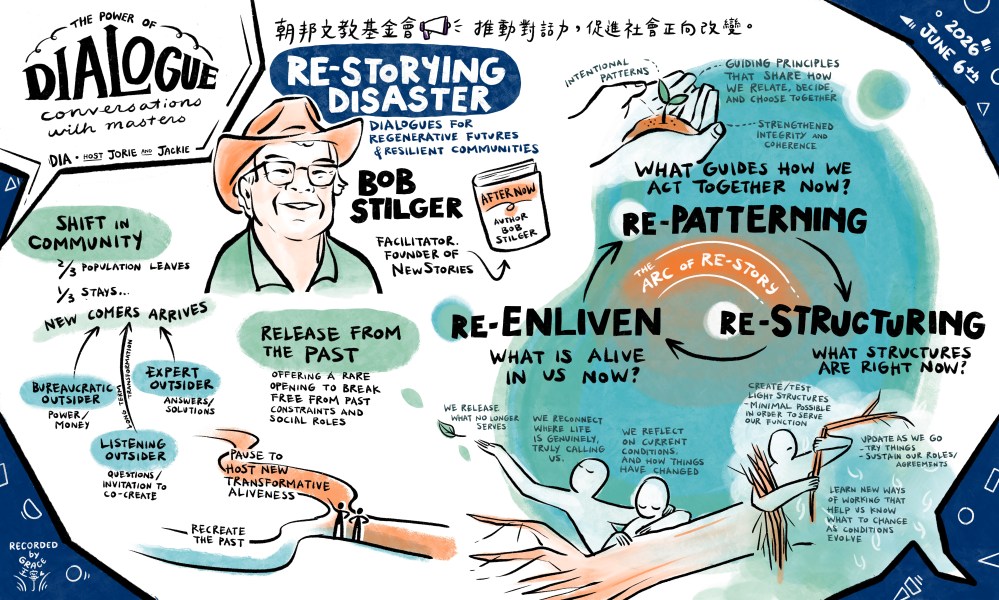
graphic recorder: Grace Wang
Notes and Reflection by Larry Philbrook, IAF-emeritus ,
Board director CP Yen Foundation and ICA-Taiwan
I have known Bob Stilger and his work for many years, this session, hosted by the CPYen Foundation in Taiwan, featured sharing his transformative framework for “Re-Storying Disaster: Fostering Resilient communities.”
The starting point for this work is that a catastrophe has happened. This is not dealing “what if” but “what now.” Drawing from his extensive work in post-disaster Japan and wildfire-affected communities in California, Bob demonstrated how disasters can serve as profound catalysts for transformation rather than crises to recover from.
Through structured dialogue, personal storytelling, and breakout discussions, participants explored how communities and individuals can move beyond recovery toward generative futures.
What does it mean to Re-Story? It means to begin to create a new story again at a moment when the old story has been destroyed, so part of what is happening is a healing process for each person involved and the community or structures that once were.
“Re-Storying Disaster" is a community-led resilience framework that shifts focus from simply rebuilding physical structures to collectively healing communities and co-creating equitable, life-affirming futures. Instead of forcing a return to a vulnerable “old normal," it tries to empower survivors to write a new narrative of connection, reciprocity, and shared survival.
Key Principles of Re–Storying
- Collective Healing: Moving past just replacing what was lost to support emotional and community-wide healing.
- Community Leadership: Letting locals take charge of their regenerative futures rather than relying entirely on top-down, outside interventions.
- Systemic Resilience: Identifying and dismantling outdated or fragile systems to build equitable, interdependent structures that withstand future shocks.
Re-Storying begins with different questions than we usually think of in relief or even facilitation:
- What is becoming possible now?
- What wisdom already exists within this community?
- How do we rebuild relationships alongside infrastructure?
- What would regeneration—not simply recovery—look like here?
This is a process of living cyclical, relational and most of all emergent lives.
One of my favorite stories from Bob was when he encountered a taxicab driver in the disaster region in Japan who confided, “Don’t tell anyone else, but I’m having more fun than I’ve ever had in my life.” This wasn’t callousness but liberation: “He was no longer constrained by the social role that he was in, by the corporate role that he was in, by the family role that he was in. He was free to pursue other possibilities. He was free to look at something else. There was space.”
Bob was careful to frame this: “Not wanting in any way to glamorize disaster, not wanting in any way to ignore the grief, the trauma, the loss, the death. But when those occur there is also a possibility to do something else. That’s where we can start to re-story disaster.”
The Re-Storying framework consists of three interconnected, cyclical stages:
- Re-Aliving is the foundational first stage, addressing the question: “What’s alive in us now?” Bob explained: “What is it that we want to move forward with?
- Re-Patterning follows once aliveness has been reinvigorated. This stage asks: “What are the patterns that hold and support and host that aliveness?”
- Re-Structuring becomes possible once the larger hosting pattern is visible. Bob described this as creating “the structures and the scaffolding that supports the new lives that we want to live. And that’s always a process of trying, seeing what happens, reflecting on it, doing it again.”
Bob emphasized the framework’s essential characteristics: “This is a cyclical process. It’s not a one and done. It’s living, it’s cyclical, it’s relational, and most of all, it’s emergent. It goes every direction. It’s not predictable. Part of what we have to do is we have to stay with the aliveness. We have to find it, we have to support it, we have to follow it, we have to lead it. All of those things go on simultaneously.”
Finally he looked at where we are now, the current global situation using the term a “confluence of catastrophes, things keep breaking down” everywhere, providing feedback that “the ways that we’ve been living as human beings on this planet are unsustainable, neither for the planet nor ourselves.”
At this crossroads, Bob identified two paths: “We can either double down and try to go back to the way things were, believing that the way ahead is basically a mirror of the way behind. Or, we can pause, and we can start to ask each other, what’s truly alive. What do we want? How do we host that aliveness and go in a different direction?”
Bob closed with a sobering timeline perspective, referencing “Regeneration After Collapse,” which documents 600-800 year regeneration arcs following civilizational collapses 2,500 and 4,500 years ago. He emphasized: “What we’re talking about… won’t be resolved in our lifetimes. Soon enough, everyone in this room will be ancestors. The choices we make now will help our grandchildren’s grandchildren walk with greater confidence along new pathways” The question becomes: “How do we live well within that time of transformative change?
AFTERWORD
As Bob has said, we are living in an era of “confluences of catastrophes." These catastrophes are not limited to natural disasters; they also encompass domestic and international political conflicts, inequality, social structures, organizational transformations, and many other broad and diverse challenges.
As we continue to navigate this period of profound change, an essential question remains: How can we live meaningful lives amidst such uncertainty and relentless changes?
The CP Yen Foundation will invite Bob Stilger to lead a two-day workshop from October 16–18, offering an opportunity for deep exploration and learning through “Re-Storying Disaster: Conversations Toward Regenerative Futures and Resilient Communities."
視覺紀錄者 Grace Wang
撰文者 費樂理(Larry Philbrook)
國際引導者協會(IAF)榮譽大師、朝邦基金會董事暨文化事業學會(ICA)台灣分會理事
我與鮑伯·斯蒂爾格(Bob Stilger)及其工作結緣已久,本次由台灣朝邦基金會主辦的講座,重點分享了他關於「重新敘事災難:邁向再生未來與韌性社區的對話」的轉型框架。
這項工作的起點在於「災難已經發生」。這並非探討「如果……會怎樣」,而是聚焦於「現在該怎麼做」。鮑伯結合他在日本災後重建及加州野火受災社區的豐富實務經驗,闡述了災難如何能成為推動轉型的深遠催化劑,而非僅是需要從中復原的危機。
透過結構化對話、個人故事分享及分組討論,與會者共同探討社區與個人如何超越災後復原,邁向充滿生機的未來。
「重述災難故事」意味著什麼?這意味著在舊故事被摧毀的時刻,重新開始編織新的故事;因此,這個過程本身也是對每位參與者,以及曾經存在的社區或社會結構的一種療癒過程。
「重述災難」“Re-Storying Disaster”
是一套由社區主導的韌性框架,其焦點從單純重建實體結構,轉向集體療癒社區,並共同創造公平且肯定生命的未來。它不強迫人們回到脆弱的「舊常態」,而是試圖賦權給倖存者,讓他們書寫出關於連結、互惠與共同生存的新敘事。
「重述災難」的核心原則
- 集體療癒:超越單純彌補損失,以支持情感層面及整個社區的療癒。
- 社區領導:讓當地居民主導自身的再生未來,而非完全依賴自上而下、來自外部的干預。
- 系統性韌性:辨識並拆解過時或脆弱的系統,以建立能抵禦未來衝擊的公平、相互依存的結構。
「重述敘事」所提出的起點問題,與我們通常在救濟工作甚至引導過程中所思考的截然不同:
- 此刻,什麼正在成為可能?
- 這個社區內部已經存在哪些智慧?
- 我們該如何在重建基礎設施的同時,重建人際關係?
- 在此地,再生——而非單純的復原——會呈現何種樣貌?
這是一個循環、關係導向,最重要的是充滿新生的生活歷程
鮑伯講過一個我最喜歡的故事:他在日本災區遇到一位計程車司機,對方向他傾訴:「別告訴別人,但我現在過得比這輩子任何時候都開心。」 這並非冷漠,而是解脫:「他不再受制於自己所處的社會角色、企業角色或家庭角色。他得以自由地探索其他可能性,得以自由地關注其他事物。那裡有空間。」
鮑伯謹慎地闡明這一點:「我絕不希望美化災難,也絕不希望忽視悲痛、創傷、損失與死亡。但當這些發生時,也存在著做其他事情的可能性。這正是我們開始『重述災難故事』的起點。」
「重述敘事」框架由三個相互關聯、循環反覆 的階段組成:
- 「重現生機」是奠定基礎的第一階段,探討的問題是:「此刻,我們內心有什麼是充滿生機的?」鮑伯解釋道:「我們想要帶著什麼繼續前行?」
- 『重塑模式』緊隨『重活』之後展開。此階段探問:「哪些模式能夠承載、支持並容納這份生命力?」
- 『重建結構』當更宏觀的承載模式清晰可見時,「重建結構」便成為可能。鮑伯將此描述為建立「支撐我們所嚮往的新生活的結構與支架。而這始終是一個不斷嘗試、觀察結果、反思並再次實踐的過程。」
鮑伯強調了這個框架的本質特徵:「這是一個循環的過程。它不是做一次就結束的事。它是充滿生命力的、循環的、具有關聯性的,最重要的是,它是自發形成的。它朝著各個方向發展,無法預測。我們必須做的一件事,就是保持這種生命力。 我們必須發掘它、支持它、追隨它、引導它。所有這些事情都在同時進行。」
最後,他審視了我們當前的處境——當今的全球局勢,並以「災難交匯」一詞來形容,指出各地「事物不斷崩解」,這正反饋出「人類在這個星球上迄今為止的生活方式是不可持續的,無論對地球還是對我們自身而言皆然。」
在這個十字路口,鮑伯指出了兩條道路:「我們可以加倍努力,試圖回到過去的狀態,相信前方的道路基本上是後方的鏡像;或者,我們可以暫停下來,開始互相詢問: 什麼才是真正充滿生命力的?我們想要什麼?我們該如何承載這份生命力,並朝著不同的方向前進?」
鮑伯最後以一個發人深省的時間軸觀點作結尾,援引《崩潰後的再生》(Regeneration After Collapse)一書,該書記錄了2,500年前與4,500年前文明崩潰後,歷時600至800年的再生週期。他強調:「我們所談論的……不會在我們有生之年得到解決。 「不久之後,在座的每個人都將成為祖先。我們現在所做的選擇,將幫助我們的曾孫輩以更大的信心,沿著新的道路前行。」問題在於:「在這段充滿變革的時期裡,我們該如何活得有意義?」
後序
誠如鮑伯所言,我們處在”災難交匯”的時代 。“災難”不只是自然災難,還有國內外政治糾紛、平等差異、社會結構、組織變革等,更廣義及更多元的情境。我們將持續探討在這段充滿變革的時期,如何重述災難 浴火重生? 我們如何活得有意義?朝邦基金會將邀請Bob Stilger 在10月16-18日之間,進行 兩天工作坊, 深度探討與學習 「重新敘事災難:邁向再生未來與韌性社區的對話」 敬請期待!

