
Topic: “ 在迷宮中傾聽——將對話作為複雜時代的實踐 Listening in the Labyrinth: Dialogue as a Practice for Complex Times”
Narrative as a Natural Path to Dialogue, with Jules Yim
From <The Power of Dialogue- Conversations with Masters> series
Written by Llarry Philbrook, CPFIEBoard director, ICA-Taiwan CP Yen Foundation
As part of the continuing CPYen Dialogue with Masters programme, it was a pleasure to meet Jules Yim and discuss her work. Cynefin has been an area of exploration for me since I first ran into it about six years ago, but this was the first time I had actually connected with someone from the company, one of the people working to make it more accessible to the rest of us. The focus of the evening was not the Cynefin model itself but sense-making. This mattered, because it helped us look at how we listen and how we speak in ways that are natural to us while also allowing deeper learning to emerge.
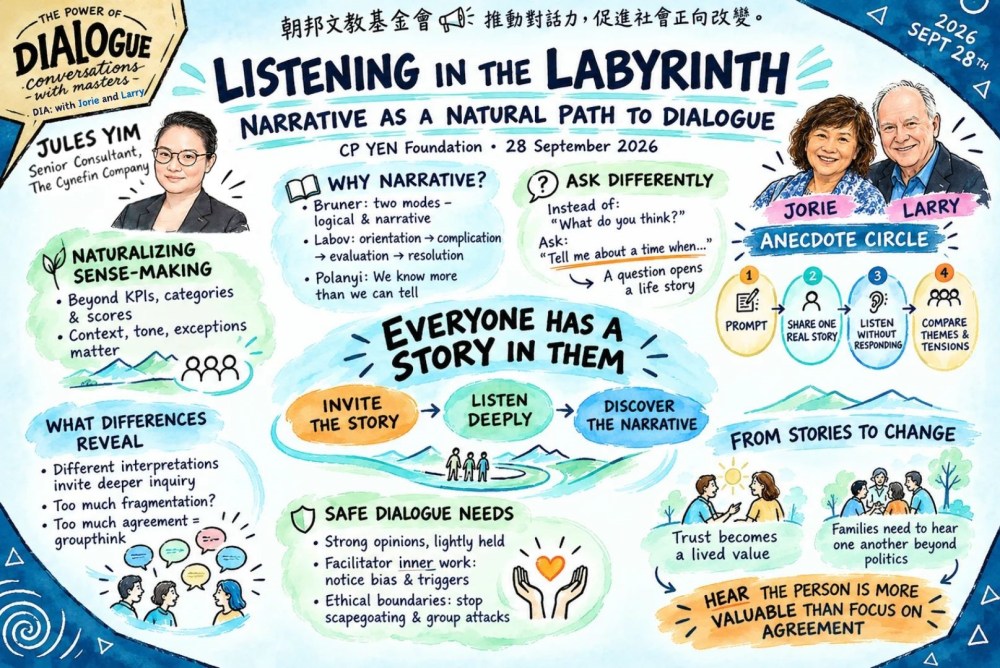
Jules joined us from Chiang Mai. She is a Senior Consultant with The Cynefin Company, and she started from a place I found very helpful: what Cynefin calls naturalizing sense-making. For many years, she said, organisations have tried to understand people through KPIs, categories and scores. She called that “forced abstraction”. And when we force it, the context, the tone and the exceptions may all get lost. So instead of building artificial structures, they look at what human beings already do naturally and design around that. As she put it, “the sophistication lives in the way we hold the space, the way we listen, and the way we design the questions we ask.”
What do human beings do naturally? We tell stories. Every culture has them, from Aesop to Journey to the West. Jules grounded this in three thinkers:
- Jerome Bruner (cognitive psychology): the mind works in two modes, the logical, categorical (“paradigmatic”) mode and the narrative mode. The narrative mode is warm, contextual and sequential, the natural way we recall and share experience.
- William Labov (sociolinguistics): everyday spoken stories share a structure (orientation, complication, evaluation, resolution), and the evaluation is where the narrator’s real insight sits.
- Michael Polanyi (knowledge management): “We know more than we can tell.” You cannot write forty years of experience into forty pages; narrative is how tacit knowledge is drawn out and passed on.
She also drew a distinction between narrative and storytelling. “Storytelling” often suggests something crafted or fictional, while “narrative” is rooted in real experience and reflects the narrator’s own perspective.
Then she made it very practical. If I ask you, “What do you think about this?”, you give me a position you have already decided on, and you may start to defend it. If I ask, “Can you tell me about a time when…?”, something different opens up. Her example was a taxi ride in Chiang Mai. There has been real tension in Thailand about tourists who don’t respect local customs. If she had asked the driver what he thought of tourists, she would probably have got his worst experiences. Instead, almost without thinking, she asked him about the two years he had worked in Bangkok. And the stories came. He had been so unhappy there; the pace of life was not his. So he came home, earning less but much happier, because for him happiness mattered more than money. Then he told her about growing up in the villages outside the city, and how easy and carefree life had been. One invitation, and a whole life came out. “Everyone has a story in them,” she said. For me, this is the key piece she explored, we invite the story, but we invite it in order to get to the narrative.
She then walked us through one method she uses for this, the Anecdote Circle:
- The prompt. One or two prompts for the whole workshop, built on experience. For example: “If a friend were thinking of joining your company, what story would you tell to encourage or discourage them?”
- The story. Each person shares one short, real story of a minute or two. No crosstalk, no responding, “because we listen much better when we’re not trying to respond.”
- The listening. Everyone else simply listens, deeply and silently, and writes down what they heard.
- The comparison. The group puts the notes side by side and looks for the themes and the tensions.
The comparison is where it gets interesting. Two of us may hear one story the same way and hear another one completely differently, and that difference is the invitation to go deeper. If everyone hears everything differently, the system may be fragmented. If everyone hears everything the same, it may be groupthink. Even an argument, Jules said, is not a bad sign; it is often what needs to be aired. She likes to do this face to face, outdoors or as a walk-and-talk if possible, with two to three hours so no one feels rushed. The stories stay in the small group, because they can be personal, and people often leave feeling they have made three or four new friends.
We both acted as a panel for the last bit, and I shared two stories of where narrative shows up and transformed my own facilitation. In the first, I was working in China with a group of leaders discussing their core values. The youngest, newest member stayed silent for fifteen minutes, then said they could not claim trust as a value, because the rest of the company did not trust his team. He was not defending his department; he was saying that if trust is our value, we have to live it. Everything in the room changed, and a meeting meant to simply approve the consultants’ list became a much deeper conversation about how to live into that value. The second was a dialogue in Hong Kong during the street protests just before COVID. Different generations in families felt very differently about what was happening, and we discovered that what was tearing families apart was not only the politics, but that they could not truly hear each other.
Jules was honest that narrative and dialogue can also be used as weapons, to manipulate people and amplify division. To safeguard the process, we explored three principles:
- Strong opinions, lightly held. This is the saying Jules lives by: form well-informed views, stay open to changing them, and let them be changed through dialogue with other people, not by going further down our own rabbit holes.
- Facilitator inner work. The facilitator holds the container for dialogue, so it begins with self-cultivation (修身) and awareness of our own biases and triggers because “even one sentence we say can be taken very seriously by someone in the workshop.”
- Ethical boundaries. If a dialogue turns into scapegoating or a group attack, the facilitator must step in and stop it to keep the container safe.
What I took away was a reminder of the gift of dialogue. We give a prompt, but we don’t know what stories will come, and we don’t know what our narrative is until it emerges. Since that conversation in Hong Kong, my question has been how we support authentic dialogue, not only requiring decisions, but for reconciliation and understanding. Jules gave me a clear way to see why the invitation to a story matters so much: it lets me truly hear the other person before we explore agreement, disagreement or anything else. And it reminded me that this starts with me, noticing my own biases and triggers as I hold the space for others.

